
From the mid-to-late 18th century, the Enlightenment Period was in full swing, as was the Industrial Revolution. Enlightenment threatened the ideology of traditional religious doctrines and the authority of the clergy, as the promotion of logical reason and science threatened the ideas of divine right that so many had been brought up to believe. One movement in particular was the rise of Deism, which emphasized a rational approach to faith and challenged traditional Christian beliefs. To compromise, the 18th and early 19th centuries saw the revival of various religious sects, in particular the reintroduction of Methodism and Evangelicalism.
John Wesley and the Methodist movement emphasized personal faith, emotional worship, and outreach to the poor to target the class divide created by the various conflicts in the late 17th century that had barely been addressed as England gathered its wits. His teachings and tactics of open-air preaching campaigns were incredibly effective and spread his words to thousands across England.
A primary factor in the Age of Enlightenment was the Industrial Revolution, which brought new technologies and faster, more efficient production methods. The Industrial Revolution transformed England completely, leading to the growth of cities, factory work, and a new industrial working class. In a few select cases, social mobility increased, but for most, class inequality was rampant, with most if not all laborers living in abject poverty.
Of course, there were those who opposed these new developments, in particular Evangelical Christians and reformers, who campaigned against the systems of slavery and child labor, as well as the normalization of poor and dangerous working conditions. While it was a long and difficult process, there was change within the system, like the abolition of slavery in England in the early 19th century, driven by Evangelical activists like William Wilberforce.
With the 19th century came the first period of globalization, which necessitates a focus on the Western hemisphere. The mid-19th to mid-20th century in the United States was marked by industrialization, labor movement, and ideological struggles following the end of the Civil War.
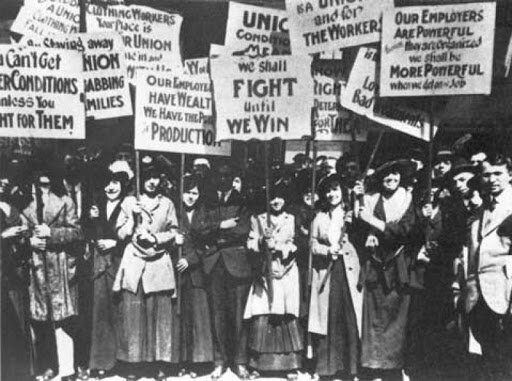
Rapid industrialization created vast economic inequality, with a small elite controlling the majority of the money, with a wealth gap rivaling the numbers of today. Labor unions emerged to demand fair wages, shorter workdays, and improved conditions in organized strikes, meetings, and conventions. While not all of these calls to action ended well– like the Haymarket Affair, in 1866, which highlighted the tensions between laborers and industrial elites, with calls for justice and equity ending in a planted bomb exploding and random individuals persecuted for political ideology– there were developments made.
The rate at which economic growth was increasing was proportional to widespread corruption and exploitation of workers. Dubbed “The Gilded Age,” the government allowed the market to do as it liked and rarely implemented restrictions or requirements for workplace safety or fair wages. This allowed growth to rise exponentially but came at the cost of an increasingly dissatisfied lower class– most of which were immigrants. Laws were passed that even further restricted the rights of the laborers, such as those that made the persecution of workers on strike easier while enabling richer employers who had government officials in their pockets.
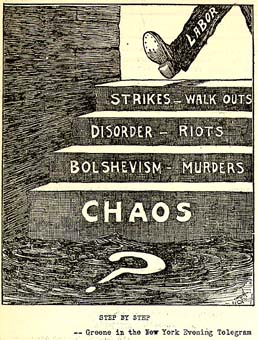
Inspired by the Marxist ideals that had begun emerging in the 19th century, communism and socialism gained popularity among labor organizers sick of the capitalist system that was restricting their freedom during the early 20th century. This movement faced significant opposition and backlash during the Red Scare, which coincided with the Russian Revolution and had roots in the hyper-nationalism of the First World War. The government cracked down on suspected radicals and targeted in particular far-left organizations, framing their calls for economic justice as threats to American values, in systemic acts like the Palmer Raids (1919-1920.) It seemed that distrust between the working class and the upper class was increasing alongside the dissatisfaction of the workplace environment, with the working class continuously suffering at the hands of systemic inequality and organizing movements to counteract that, and the upper class drawing the conclusion that the logical next step to labor strikes and walkouts was communism.
Cultural shifts paralleled these socioeconomic transformations. The Victorian Era emphasized moral reform and societal progress, which influenced movements for education and public health improvements. Urbanization brought significant challenges, such as overcrowded living conditions and rising crime rates, prompting reformers to advocate for better infrastructure and public services. Progressive movements in the late 19th and early 20th centuries worked to further address these issues, achieving milestones such as the establishment of labor laws and the expansion of voting rights.
Technological advancements further shaped society: the invention of the telephone, expansion of railways, and the advent of electricity revolutionized communication, transportation, and daily life. These innovations not only improved productivity but also widened the gap between industrialized nations and their colonies, fueling the expansion of imperialism in the Western hemisphere.
These rapid and dramatic transformations driven by industrialization, social reform, and technological transformation laid the groundwork for the modern era, shaping the political, economic, and cultural dynamics that continue to influence society today.