
The earliest record of Robin Hood was as early as the end of the 14th century when bards and poets passed down stories through primarily oral tradition. Although Robin Hood existed in now lost folktales prior to the mid-14th century, the first literary reference to him was in Sir William Langland’s Piers Plowman, in a brief satirical comment on the corruption of a clergyman– “I kan nat perfitly my Paternoster as the preest it syngeth/But I kan rymes of Robyn Hood and the Randolf Erl of Chestre” (Passus V, lines 401-402). Come the early 15th century, though, the first tales of Robin Hood were recorded in the form of rhymed verse.
One such poem was the Gest of Robyn Hode, a collection of poems detailing Robin Hood’s misadventures as a “freborn blode[d] / …gode yeman” and a “prude outlaw” dated back to approximately the 1410s (Gest, lines 5-9). Here, there are two key distinctions to be made: the social class of Robin Hood as a yeman, or yeoman, as well as the definition of an outlaw.
Now no longer a commonly used term, the yeoman was the social rank below the nobles, ranging anywhere from lower officials to the royal houses. Born from a long-standing culture of feudalism in medieval England, to call someone a yeoman was to call them a member of the common folk, and more of a vague generalization, if anything (Knight, 48n).
Outlaw, however, has a more interesting definition, as it was used differently than how one living in modern times would expect. Outlawry could be both a civil and criminal declaration, based solely on public accusation and the discretion of a sheriff. For fear of cruel and unreasonable punishment, even those who committed only minor crimes often failed to appear in court, leading to the declaration of outlawry. With this in mind, many a common yeoman became an outlaw for minor offenses, like being short on taxes– rent– or an act of the vaguely defined “rebellion.” These outlaws did not stray far, either, seeking refuge in churches, or simply living for free off of the vast and often unguarded lands of the upper class.
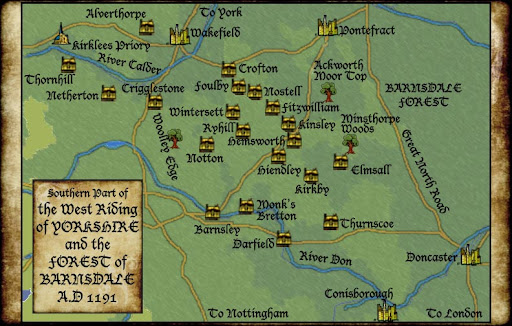
Set in Barnsdale, assumed to be near modern-day Yorkshire, there isn’t a clear backstory for Robin Hood of the Gest of Robyn Hode, so it is never clearly established why exactly Robin Hood is an outlaw. That aside, he spends much of his free time stirring trouble for those he believes to be corrupt, so it can be assumed that it must be some kind of rebellion.. He behaves in a judgemental fashion, often lying in wait along the roadside and subjecting unsuspecting pedestrians to rather arbitrary tests of morality, in particular those who seem to be of a higher class than him. In fact, Robin Hood states that “‘Therof no force…/We shall do well inowe/But loke ye do no husbonde harme/That tilleth with his ploughe’”(Gest, lines 49-52). That is, Robin Hood refuses to attack a fellow yeoman who works hard for their money, as he is their champion.
Often, his victims end up being sheriffs (one character would later on become misnamed as the “Sheriff of Nottingham,”) religious officials, and even knights. Of these, he plays increasingly violent pranks, ranging from tame robbery to chopping the sheriff's head off and cashing it in as his own for a cash reward. His choices in who to target are a far cry from the more familiar tune of justice oriented robbery– rather, his victims are simply whoever passes through his trap first and whoever seems to rub him the wrong way.
Indeed, the Sheriff of Nottingham, who later takes on a much larger role in the Robin Hood canon, does not play much of a part within the Gest. In fact, Robin only interacts with a Sheriff once in the entirety of the Gest– to chop off his head and stick it on a pike. Instead, the Gest relies on a rotating cast of side characters alongside Robin Hood, Little John (Littel John), and Will Scarlet (Willyam Scarlok,) the only three members of his later much acclaimed Merry Men. Despite this, many of Robin Hood’s initial victims were in some way shape or form associated with the church and often depicted as corrupt, greedy, and gluttonous individuals in need of disciplinary violence and robbery at the hands of Robin Hood. In one adventure, Robin encounters a monk who refuses to show him respect– “Robyn dyde adowne his hode/The monke whan that he se/The was not so curtesyse/His hode then let he be”– the monk doesn’t lower his hood upon greeting Robin Hood, doesn’t wash his hands when he sits down to eat, and does not thank Robin Hood for the food offered to him (Gest, lines 901-905). As a result, Robin robs the monk of all his possessions and sends him on his way with an admonishment to be respectful, a stab wound, and a remarkably lighter money purse.
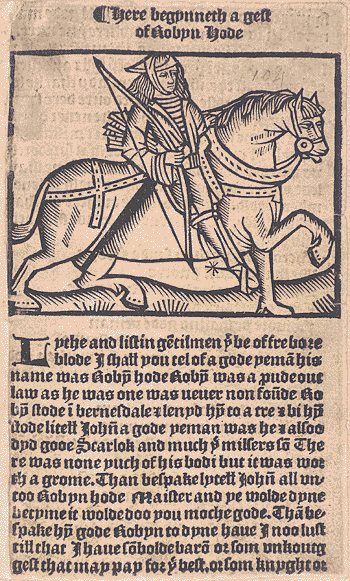
The general sentiment of Robin Hood’s anti-clerical behavior is deeply embedded in the culture of medieval England at the time. Such depictions of exaggerated behavior demonstrated by high-ranking religious individuals served as satire, appealing to a general audience who craved subversion of not only the political establishment which kept them in the lower classes but also of religious authority, especially in the rigid hierarchies of medieval society.
Robin Hood’s own religious beliefs are somewhat comedic. He is sometimes portrayed as a devout Catholic (in his unending devotion to the Virgin Mary, which has an “ironic poignancy when we recall that he is murdered by a religious woman” at the end of the Gest), and sometimes painted as the complete opposite of that (in acts of unnecessary violence)(Knight, 49n). In general, Robin Hood practices a form of popular Christianity, aligning with the beliefs of the ordinary people rather than those of the elite clergy. While he attends mass and respects certain traditions, his actions also mock or criticize institutionalized religion. One such example is in his actions: most of his victims follow the strict rules of Medieval Christianity, but thwart them in some way or another with loopholes. Robin Hood, on the other hand, is tied to his moral code rather than strict adherence to doctrine. He embodies values such as generosity (in offering respectful travelers “free” food,) loyalty (in protecting and avenging those who have helped him in the past,) and protecting the weak (in defending those wronged by the corrupt church,) but isn’t afraid to break the rules.
Thus, Robin Hood’s stance as both the upholder of justice in his criticisms of the Church and his simple beliefs of Christianity create a persona with both religious and secular appeal. His religious beliefs are another demonstration of the political sentiment he represents: that of a need to dismantle the corrupt system of hierarchy within medieval England.